Cart
0
A reflection on slow and fast fashion, and the choice that defines us.
It is early morning. Somewhere in the Murshidabad district of Bengal, a weaver sits before his loom. His fingers move the way they always have, unhurried, deliberate, carrying within each motion the memory of a technique passed down through generations. A single saree, woven this way, might take weeks. Sometimes months.
And somewhere else, in an air-conditioned warehouse on the other side of the world, a machine runs through the night producing hundreds of garments before sunrise. Each one a replica of the last. Each one destined, more likely than not, to be worn a handful of times and forgotten.
I find myself returning to this contrast often. Not with anger, but with a deep, quiet curiosity. Because the question it raises is not simply about fashion. It is about what we value. What we are willing to pay for, not just in money, but in time, in care, in conscience.
The Speed We Mistake for Progress
Fast fashion seduced the world with a beautiful promise, that style could be democratic. That the runway could reach everyone. And there is something genuinely powerful in that idea.
But the cost of that speed was never printed on the price tag.
The cost lives in the rivers of countries like ours, run blue and silver and acid-green with dye. It lives in the hands of the garment worker earning wages that don't account for their dignity. It lives in landfills growing taller every season, swallowing mountains of discarded polyester that will outlast all of us. It lives in the erosion of craft traditions so ancient and intricate that once they're gone, no algorithm can recover them.
Fast fashion taught us that clothing is disposable. And when we began to see our clothes that way, something shifted in how we saw the people who made them, too.
What Slowness Actually Means
When people first encounter the phrase "slow fashion," they sometimes imagine it as a kind of luxury for the privileged, the few who can afford to wait and to spend. But that, I believe, is a misunderstanding.
Slowness is not about price. It is about presence.
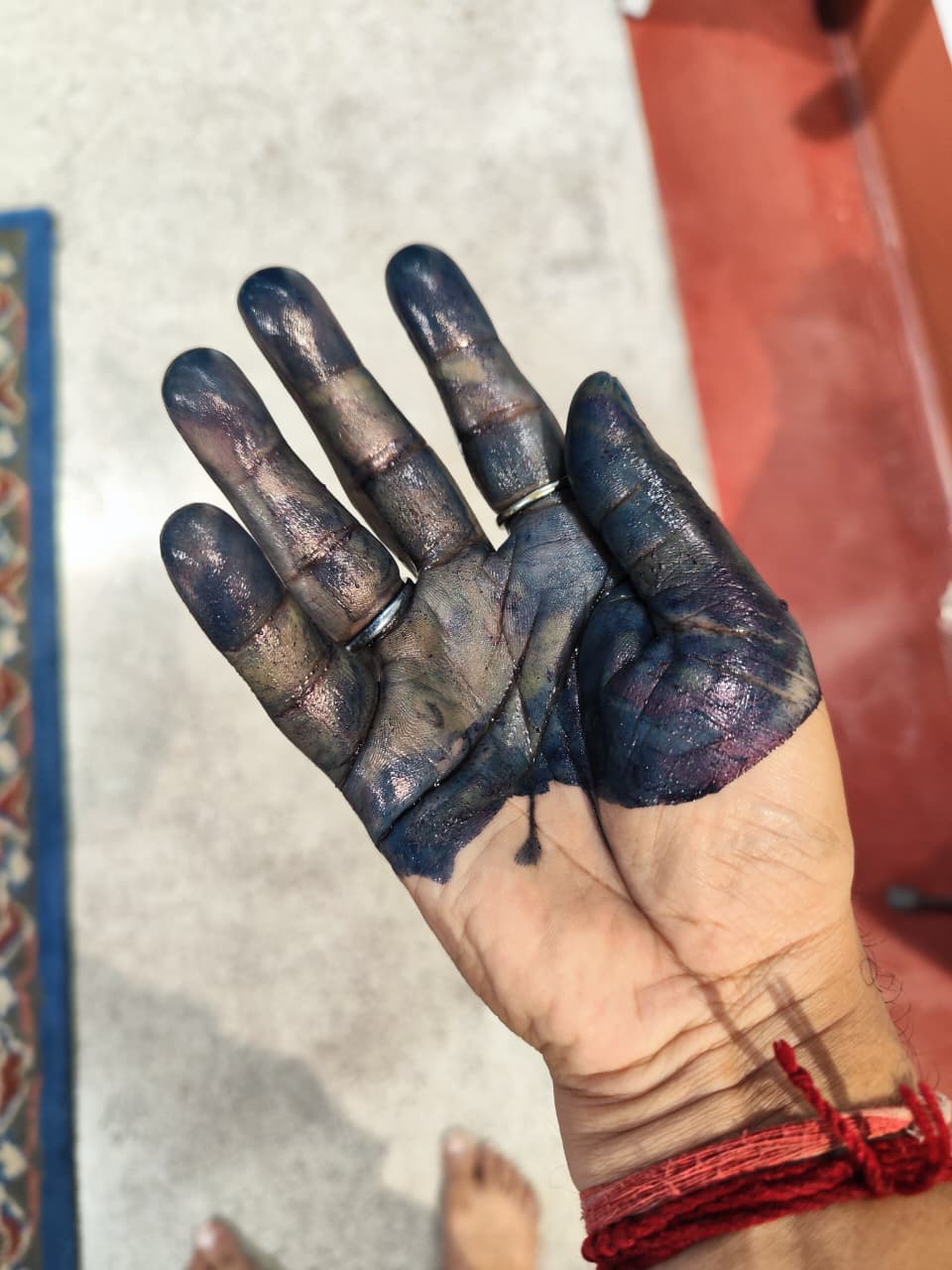
It is the farmer, the spinner, the dyer and weaver's presence in every thread. My own presence in every design choice. The presence of the earth in every natural dye. The indigo, the turmeric, the madder, colours that carry in them the memory of a soil, a climate, a history. And finally, the presence of the person who wears the cloth, who chooses it not because a trend demanded it, but because something in it spoke to them.
Slow fashion is, at its core, the act of paying attention. To process. To provenance. To people.
The Loom as a Living Argument
Every time I sit beside a weaver in the clusters of Shantipur or Bishnupur, I am reminded of something the fast fashion world cannot manufacture the intelligence of the hand.
A handloom weaver is not simply executing a pattern. He is negotiating with the yarn, reading the tension of each warp thread, making hundreds of micro-decisions per minute that no machine has yet learned to replicate. The thread he holds has been dyed by a dyer, and had been made into its current state with the help of a spinner. And the cotton, the raw material that composes it was grown by a farmer after months of love, care and toil. The textile that emerges carries within it this negotiation, this story and the many journeys the thread carries even before its woven. You can feel it when you touch it. There is a warmth, an irregularity, a life in it.
That life is the story slow fashion tells. And it is a story worth preserving, not behind glass in a museum, but on bodies, in wardrobes, in daily life.
A Different Kind of Investment
I think of the garments I have designed over the years, and I think of the people who carry them. There is a woman in Mumbai who wrote to me that she wore a piece of mine to her daughter's wedding and then again to her daughter's child's naming ceremony, years later. There is a man in Kolkata who tells me his wife reaches for a particular khadi blouse on every important day of her year.
These are not stories about fashion. They are stories about relationship, between a person and an object that was made with intention.
Fast fashion does not create these relationships. It cannot. It is not designed to. It is designed for turnover, not tenure.
Slow fashion, on the other hand, asks you to invest and in doing so, asks you to commit. To a garment, yes. But also to the weaver, the dyer, the spinner, the farmer and the hands that go behind it. To the tradition behind them. To the earth that yielded the fibre and the colour.
The Harder Question
I do not believe slow fashion is a simple moral high ground. It asks things of us, patience, spending power, a willingness to resist the pull of what is new and trending. These are not small asks in a world built to move fast.
But I do believe we are at a moment where the question is no longer whether fast fashion is harmful. The evidence is overwhelming. The question is now whether we are willing to participate in building an alternative.
And that alternative does not have to be perfect. It does not have to mean buying only handloom, only natural fibres, only certified sustainable labels. It can begin much more simply with the question: Do I need this? And if I do, who made it, and how?
That question, asked sincerely, is the beginning of a different kind of relationship with what we wear.
What I Carry Forward
At Manas Ghorai, we have never been in the business of trends. We have been in the business of stories, of weaves that carry within them centuries of knowledge, of colours drawn from the living world, of textiles that are meant to last not just one season but one lifetime.
We move slowly. Deliberately. Because that is the only way the work can carry what it needs to carry, the dignity of the weaver, the integrity of the craft, and the quiet conviction that what we make matters.
The loom does not hurry. And neither do we.
Because some things, made fast, are made cheap. And some things, made slowly, are made to last.
That is the choice. And it is always ours to make.